A home backup power calculator needs to answer three different questions: how much energy the outage will consume, how many watts the appliances draw together, and whether the power source can handle the largest startup surge. Choose only the loads you actually need, replace the example figures with label or meter readings, and set how long each load will run.
Last updated: October 18, 2026
Build your outage load budget
The starting values are planning estimates, not measurements. Check each appliance label or use a plug-in power meter.
Planning class: roughly 1.3 kWh rated, with at least 305W continuous output and 1,355W surge capability. Use the next available size above every limit.
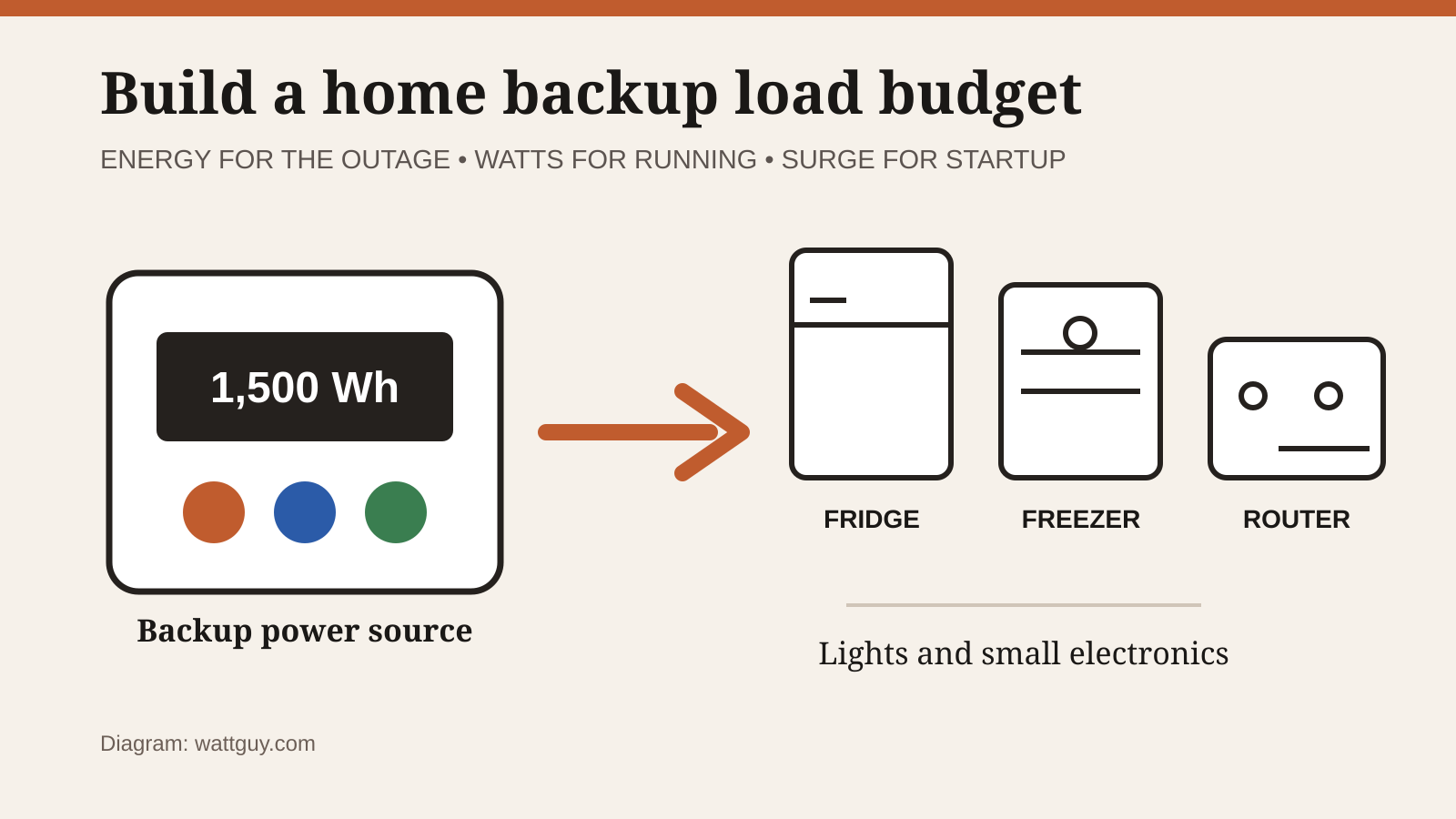
What the four results mean
Load energy is the electricity the selected appliances consume during the planned outage. A 150W refrigerator entered for two active hours contributes 300Wh, even though the outage lasts eight hours. That active-time entry represents compressor cycling. A router running for the full eight hours contributes its watt draw multiplied by eight.
Minimum rated capacity works backward from load energy after accounting for inverter loss, the usable part of the battery, and your reserve. The default assumptions make only 65% of the nameplate capacity available to the planned AC loads. A result of 1,262Wh therefore points to the next available power source above that number, not a 1,000Wh unit.
Combined running load assumes all selected devices could operate at once. The source’s continuous AC output rating needs to exceed it. Estimated startup demand replaces the running draw of the appliance with the largest motor surge by its startup figure. The model does not assume every motor starts at exactly the same instant, but real behavior can be less convenient than that assumption.
How to collect better input numbers
Start with the appliance label, manual, or manufacturer data. Running watts may also be measured with an appropriate plug-in power meter when the appliance uses a standard receptacle and the meter is rated for the load. Do not open panels, alter wiring, or improvise adapters to obtain a measurement.
Motor loads deserve extra care. Refrigerators, freezers, pumps, and some heating equipment can need several times their running power for startup. A label may state amps rather than surge watts, and a basic energy meter may miss a brief peak. Use the manufacturer’s published starting requirement when it exists. If the requirement is uncertain, leave more output headroom.
For cycling appliances, estimate active hours separately from outage duration. One useful method is to measure a representative 24-hour energy total in ordinary conditions, then scale that watt-hour figure to the outage window. Hot weather, frequent door opening, basement flooding, and equipment age can increase demand, so the measurement should resemble the conditions being planned for.
Worked eight-hour outage example
The defaults include a 150W refrigerator for two active hours, a 100W freezer for two hours, a 15W modem and router for eight hours, and 40W of LED lighting for five hours. Those loads consume 820Wh. Their combined running draw is 305W.
The refrigerator has the largest entered startup requirement at 1,200W. Replacing its 150W running contribution with that figure produces an estimated 1,355W startup demand. With 85% AC efficiency, 90% usable capacity, and a 15% reserve, the calculator divides 820Wh by 0.65025 and arrives at about 1,262Wh rated. A practical choice must clear the capacity, continuous-output, and surge-output results at the same time.
Adding a laptop for four hours contributes another 260Wh, but it barely changes surge demand. Adding a pump may do the opposite: one hour of use adds substantial energy, while its motor can also dominate the output requirement. This is why a single watt-hour estimate is not enough to size backup power.
What this calculator does not decide
This tool does not determine whether a power station, UPS, inverter, battery, or generator is compatible with an appliance. It does not model waveform requirements, voltage drop, ambient temperature, battery aging, solar weather, fuel supply, or automatic transfer equipment. Manufacturer limits and local electrical requirements still control.
Never connect a portable source to household wiring through a receptacle or improvised cord. That can backfeed utility lines and create lethal hazards. Permanently connected systems, transfer equipment, and panel work belong with qualified professionals under the applicable code.
Fuel-burning generators produce carbon monoxide. The US Consumer Product Safety Commission says a portable generator should never be operated inside a home, garage, basement, crawlspace, or shed. Follow its outdoor-distance and exhaust-direction guidance as well as the product manual.
Medical equipment needs a device-specific continuity plan, not only a calculator result. Confirm power quality, battery duration, alarms, approved accessories, and what happens during a prolonged outage with the equipment supplier and care team. Keep the recommended backup procedure available before an outage begins.
Capacity versus runtime
A battery’s Wh rating describes stored energy, while its W rating describes how quickly the inverter can deliver power. Both matter here. If you already own a battery system and want to estimate how long one steady load will run, the UPS Runtime Calculator exposes battery chemistry, health, and conversion assumptions in more detail.
Rated capacity is not the same as AC energy at the outlets. Conversion consumes some energy, manufacturers may reserve part of the battery, and shutting down before empty improves resilience. The default efficiency, usable-capacity, and reserve fields make those deductions visible instead of hiding them in a vague correction factor.
Home backup power calculator FAQ
How large a battery do I need for an eight-hour outage?
Add the energy for essential loads, then adjust for efficiency, usable battery capacity, and reserve. The default example needs 820Wh at the loads and about 1,262Wh of rated storage. Your result can be much smaller or larger because refrigeration duty cycle and pump operation vary.
Should active hours equal outage hours?
Use the full outage duration for devices that stay on continuously, such as a modem and router. Use expected run time for cycling or occasional loads. A refrigerator compressor may run only part of the window, while its controls still remain connected.
Why can surge watts be higher than running watts?
Motors and compressors can draw a brief burst of power when they start. A source with enough battery energy can still shut down if its inverter cannot supply that peak. Check both the continuous and surge ratings for the exact model and their time limits.
Can I subtract expected solar charging?
Yes, but use a conservative watt-hour estimate for the season, location, array orientation, controller, and forecast. Enter zero when the recharge estimate is uncertain. Capacity that exists at the start of an outage is more dependable than hoped-for production during it.
Method note: Calculations run only in your browser. Watt Guy does not receive the entered values. The result is a planning estimate, not a product recommendation or electrical design.