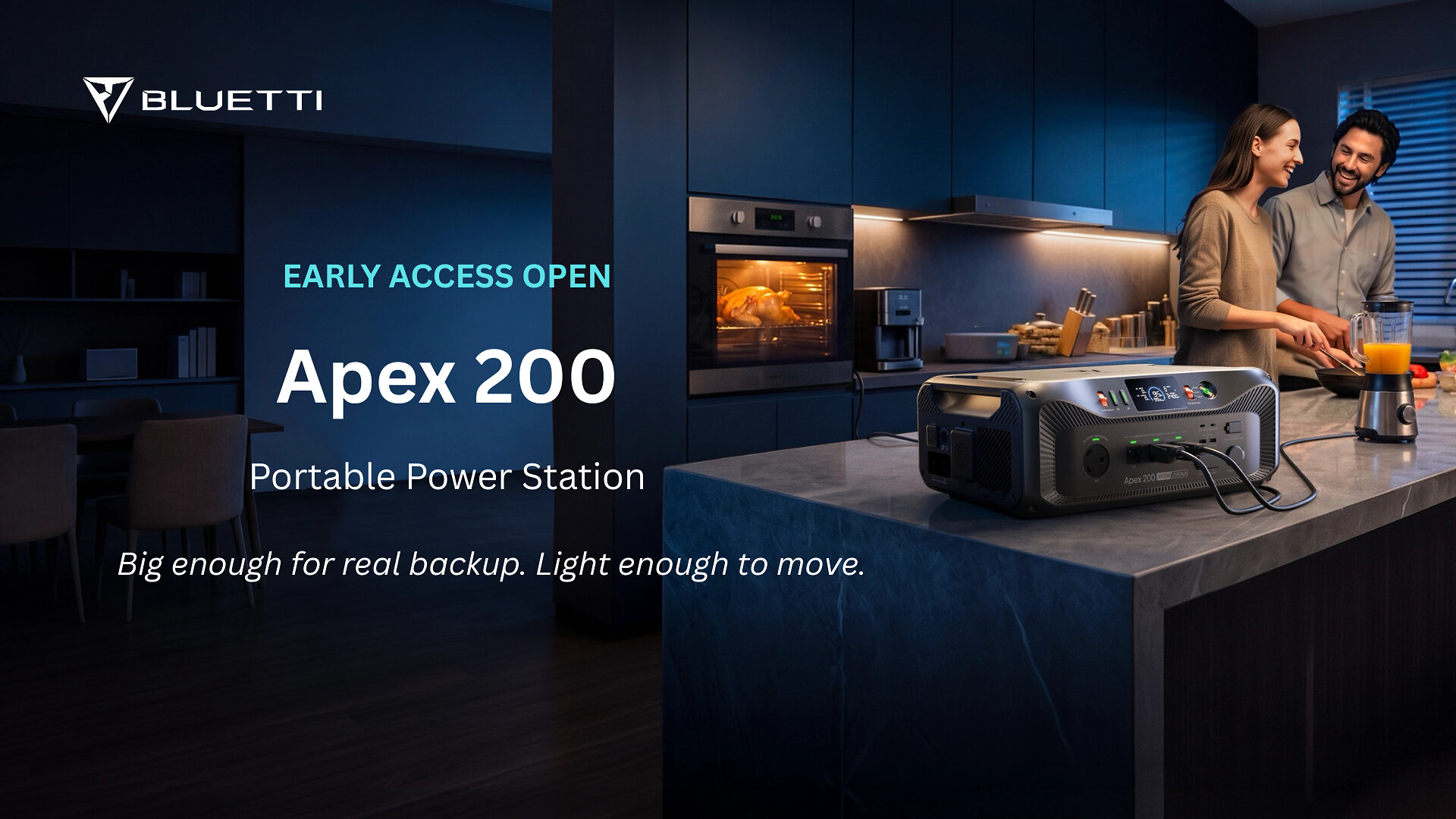
Availability, checked October 31, 2026: the BLUETTI Apex 200 is not generally shipping in Canada or the United States. BLUETTI has opened US early access and says final US pricing will arrive at launch. Its launch page names November 4 as the planned sale date, while its October 20 press release names November 5 for the US launch. BLUETTI has not announced a Canadian price or sale date, and the Apex 200 does not appear in its current Canadian Apex collection.
This is launch analysis based on BLUETTI documentation, not a review or a recommendation to preorder. Watt Guy has not handled or tested the Apex 200. The confirmed specifications describe an unusually light 2.56 kWh station with serious output, but the missing price, Canadian timing, final manual, warranty, and transfer-time details can still change the buying decision.
Launch update note: Watt Guy will update this article when BLUETTI publishes final US and Canadian price and availability, any changes in the regional documentation, and independent measurements from reputable testing if they become available.
Last updated: October 31, 2026
What BLUETTI has confirmed
The Apex 200 uses a 2,560 Wh lithium iron phosphate battery and supplies 3,200 W of continuous AC output as a standalone unit. BLUETTI says output rises to 3,600 W when a compatible expansion battery is connected or when supported solar or AC input is active. That second number is conditional, so 3,200 W is the useful base rating for comparing an unexpanded station.
The official launch material lists a weight of 59.5 lb (27 kg) and a 36.5-litre enclosure. That is movable between a house and an RV, but it is not light in the ordinary luggage sense. BLUETTI itself describes the unit as a two-hand carry.
Ten outputs cover home and RV use. The four AC outlets include a TT-30R outlet for a 30 A travel trailer, and supported outlets can be controlled individually through the BLUETTI app. The remaining outputs include a 12 V/30 A Anderson connection, two USB-C ports, two USB-A ports, and a 12 V car-style outlet. BLUETTI has not published a complete North American manual yet, so buyers should verify the final port ratings and included cables for the regional version.
Solar input is a headline feature. BLUETTI specifies up to 3,000 W combined: as much as 2,000 W through a 60 V to 280 V high-voltage input and another 1,000 W through a low-voltage input. The company claims an 80 percent recharge in about 45 minutes in Turbo mode and a full AC recharge in roughly 1.6 hours. Those are manufacturer test figures, not Watt Guy measurements, and BLUETTI says actual time varies with configuration, temperature, input power, and connected loads.
The Apex 200 trades voltage for portability
Confirmed comparison with the released Apex 300. Accessory requirements can change the complete system.
| Decision factor | Apex 200 | Apex 300 |
|---|---|---|
| Rated capacity | 2,560 Wh | 2,764.8 Wh |
| Base continuous output | 3,200 W | 3,840 W |
| AC voltage | 120 V only | 120 V and 240 V |
| Weight | 59.5 lb (27 kg) | 83.78 lb (38 kg) |
| Built-in/direct solar input | 3,000 W combined | 2,400 W combined |
| USB and DC outputs | Built in | Hub D1 required for listed USB and DC outputs |
| Largest listed single-unit expansion | 33.28 kWh with six B500K batteries | Varies by supported battery family |
The Apex 200 gives up 204.8 Wh of nameplate capacity and 640 W of base output compared with the released Apex 300. In return, it drops 24.3 lb (11 kg), adds built-in USB and DC ports, and raises built-in/direct solar input by 600 W. The Apex 300 can accept more solar through the optional SolarX 4K, so 2,400 W is not its complete-system maximum. The calculated weight reduction is about 29 percent, using BLUETTI’s published figures.
The decisive loss is 240 V output. The Apex 300 can supply supported 120 V and 240 V loads, while BLUETTI positions the Apex 200 as a 120 V system. Linking more Apex 200 units increases system output and capacity, but BLUETTI does not say that it creates 240 V service. Anyone planning around a well pump, electric dryer, range, or central air system should not assume compatibility from the total watt figure.
The Apex 200 looks more natural as a large portable station for selected plug-in loads or a 30 A RV. Watt Guy’s home-backup power station guide explains why capacity and inverter power answer different questions. A 3,200 W inverter may start a demanding appliance, but the 2,560 Wh battery still decides how long the combined load can run.
Expansion is broad, but the headline needs context
One Apex 200 supports up to six compatible B300K or B500K expansion batteries. With six 5,120 Wh B500K packs, BLUETTI lists 33.28 kWh of nominal system capacity. Three Apex 200 systems can connect through a Hub A1, and the maximum configuration uses 18 B500K packs for 99.84 kWh and up to 6,000 W of combined output.
That near-100 kWh figure is a maximum ecosystem configuration, not what comes in the portable base unit. It requires three stations, 18 large batteries, a Hub A1, connection cables, floor space, and a budget BLUETTI has not disclosed. The company also says batteries, hubs, cables, and other required accessories may be sold separately.
Large configurations also cross from portable equipment into home electrical planning. Connecting backup equipment to household circuits, a transfer device, or an electrical panel requires a licensed electrician and applicable permits. In Ontario, the Electrical Safety Authority explains notification and inspection requirements. Never backfeed a home through a wall outlet. That is illegal and can kill utility workers.
UPS mode has an important unknown
BLUETTI says the Apex 200 can switch supported connected devices to battery when utility power fails. UPS mode is disabled by default and must be enabled in the app. Smart outlet control also depends on the station being online for remote functions.
The current launch page does not publish transfer time, pass-through limits, supported shutdown communication, or a final compatibility list. Do not infer computer, server, or medical-device suitability from the letters “UPS” alone. Watt Guy’s power station versus UPS comparison shows why transfer time and shutdown control can matter more than battery capacity for sensitive electronics.
What is still unknown
Final regional price is the largest gap. BLUETTI’s manufacturer-issued October 20 press release says pricing will be announced at the US launch. Watt Guy will not repeat unconfirmed price ranges from editorial reports.
Canadian sale timing is also unknown. BLUETTI’s US page carries the detailed launch material, while the Canadian Apex collection currently lists the Apex 300 family without the Apex 200. A product that can be ordered from a US store is not automatically generally available to Canadian customers once duties, regional warranty, plug configuration, and shipping restrictions enter the picture.
BLUETTI has not yet supplied a final North American manual with the warranty term, cycle-life condition, operating temperature range, exact certifications, surge behaviour, UPS transfer time, and complete box contents. Some of those details may appear at launch. Until they do, the official Apex 200 launch page is a specification preview rather than a complete ownership document.
Who should wait
Canadian buyers should wait for a Canadian listing, price, warranty, and delivery date. Buyers who need 240 V should treat the 120 V limit as a stop sign, not a detail to solve later. People choosing backup for a desktop, server, medical device, or another transfer-sensitive load should wait for the final manual and confirm the device manufacturer’s requirements.
It also makes sense to wait if 59.5 lb is too much to move safely, or if the plan depends on the maximum expansion figure. The complete-system price and required accessories matter more than the theoretical ceiling. For a normal fridge, networking gear, and a few lights, use the Home Backup Power Calculator to size the actual load before deciding whether 2.56 kWh is generous or merely adequate.
The Apex 200’s confirmed numbers create a clear trade: less voltage and base output than the Apex 300, but far less weight, more solar input, and useful RV and DC connections built in. That is enough for meaningful launch analysis. It is not enough for a buying verdict until BLUETTI fills in the price, Canada, warranty, safety documentation, and transfer-time blanks.
How this launch analysis was researched
Watt Guy used BLUETTI’s October 20 manufacturer-issued press release, current US Apex 200 launch page, Canadian Apex collection, and released Apex 300 documentation. DataForSEO checks on October 31 found 30 monthly US searches for the exact model and thin exact-model page ones in both the US and Canada. No product was supplied, handled, or tested, and no linked company pays Watt Guy.