I replaced the sealed lead-acid battery in my APC UPS with a 12V 10Ah LiFePO4 battery, then logged what happened. In a controlled test, my home server ran for 77 minutes at an estimated average load of 54.9W before completing its shutdown. The battery supplied about 71Wh during that logged window, and its loaded voltage stayed between 12.7V and 12.2V.
Six months later, the same battery also carried the server through a real 76-minute outage and shut it down cleanly. That is the good part of my LiFePO4 UPS experiment. The catch is that the UPS still thinks it has a lead-acid battery. Its charge percentage and runtime estimate look precise, but they are not trustworthy.
This is not a blanket recommendation to put any lithium battery in any UPS. It is one measured installation, with a battery management system, a software shutdown plan, and some compatibility compromises that matter.
What I tested
The UPS is an APC Back-UPS BX1000M, rated for 1000VA and 600W. The monitoring software identifies it as a Back-UPS XS 1000M, which is the model string I see through apcaccess. APC specifies its genuine replacement as the 12V 9.4Ah lead-acid APCRBC158.
I installed a ROCKSOLAR RSLIPO12-10AH on March 7, 2026. ROCKSOLAR rates it at 12.8V, 10Ah, and 128Wh, with a 10A continuous discharge limit. The case measures 151 by 65 by 94mm, uses 6.35mm F2 blade terminals, and weighs 1.27kg or 2.8lb.
Those dimensions match the common UB1280-size SLA case. It fit the BX1000M battery bay and connected to its existing leads without an adapter. That was a true physical drop-in on my unit. It does not prove electrical compatibility with every UPS that accepts the same case.
The built-in BMS handles cell balancing and protection against over-charge, over-discharge, over-current, short circuit, and temperature, according to ROCKSOLAR. The company lists 3,500 cycles to 80% capacity. The ROCKSOLAR datasheet and manual gives a recommended charging range of 14.2V to 14.6V and says 14.6V maximizes capacity. It also lists a 13.8V float setting. ROCKSOLAR lists a charging temperature of 0 to 40C. Those limits are why I would not describe the conversion as risk-free or universally approved.
My LiFePO4 UPS discharge test lasted 77 minutes
On March 14, I pulled mains power and logged the UPS every 30 seconds. There are 156 samples from 2:10:56 p.m. through 3:28:27 p.m., a span of 77 minutes and 31 seconds.
The first transfer sample read 13.1V. By the next sample, the loaded battery was at 12.7V. It then spent almost the entire run between 12.7V and 12.4V before reaching 12.3V at the end of the log. This flat curve is the most obvious practical difference between LiFePO4 and an SLA battery.
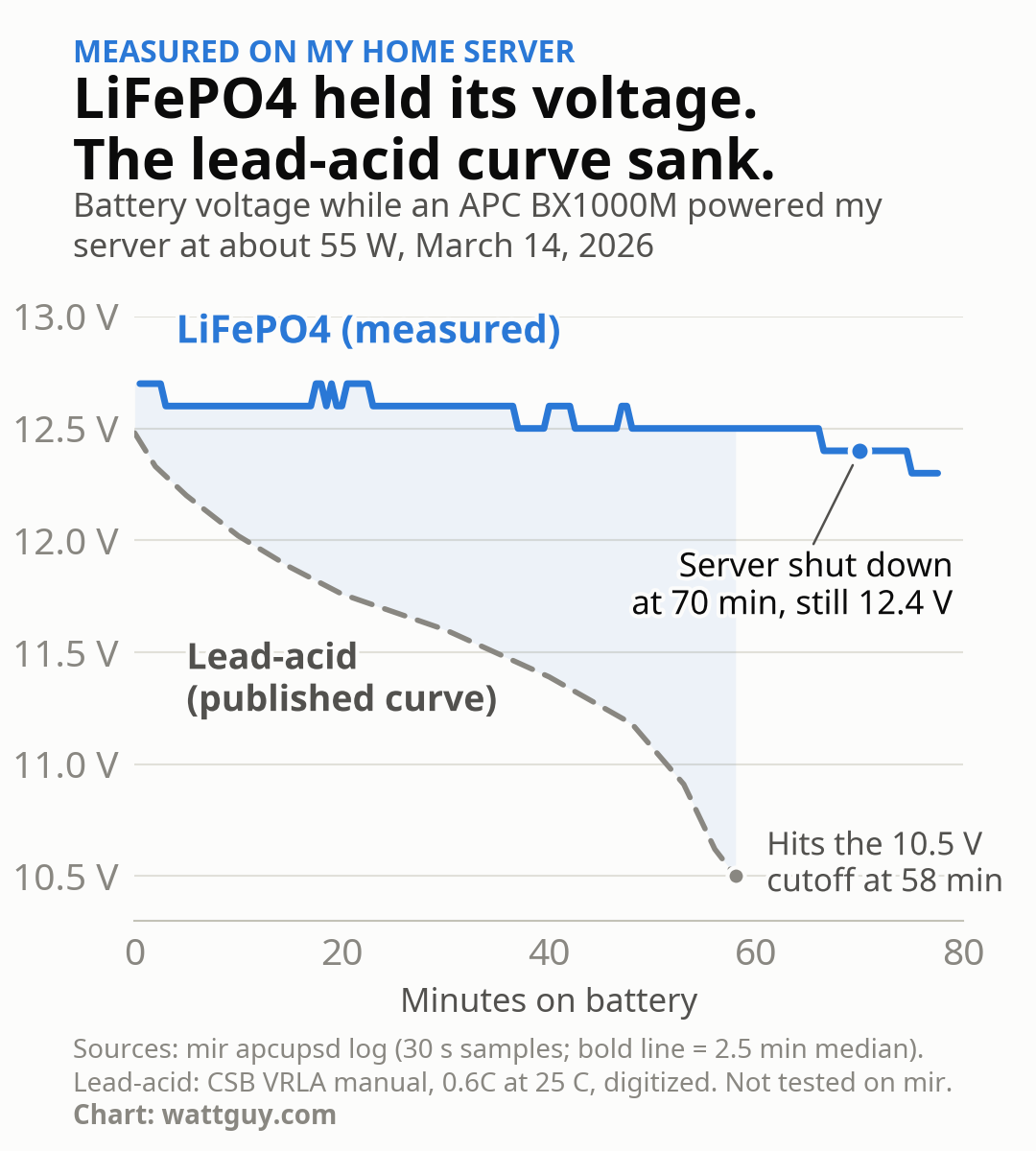
The gray reference is useful for shape, not for claiming an exact SLA runtime. CSB’s VRLA battery manual shows lead-acid terminal voltage declining throughout a discharge, then dropping sharply near the end. Battery age, temperature, discharge rate, inverter efficiency, and the UPS cutoff all change the result. I have not yet run a like-for-like SLA test on this machine.
The UPS reported a load between 48W and 60W for most of the run, averaging 54.9W. Those watt figures are estimates. Apcupsd gives me load percentage, so my logger multiplies that percentage by the UPS’s 600W rating. That is why the values move in 6W steps. I did not have a calibrated DC power analyzer in the circuit.
Integrating those estimated samples gives 71.0Wh. A separate processed file calculated 70.5Wh and 5.87Ah, which is close enough to support the result. Neither number is the battery’s full tested capacity. The server began shutting down at 70 minutes, while the battery was still at 12.4V. The logger continued during shutdown and stopped at 12.3V.
So the honest result is about 71Wh delivered to the UPS before and during host shutdown at roughly 55W. It is not proof that the 128Wh battery delivered its entire nameplate capacity.
You can enter your own load, battery chemistry, and shutdown margin in my UPS runtime calculator, which is calibrated to the 70-minute shutdown point from this test.
The UPS battery gauge was confidently wrong
At 30 seconds, the UPS said the battery was at 93% and measured 12.7V. At 38.5 minutes, it said 50% while the battery still measured 12.5V. At 70 minutes, it reported 10% and initiated shutdown at 12.4V. The final logged sample said 1% at 12.3V.
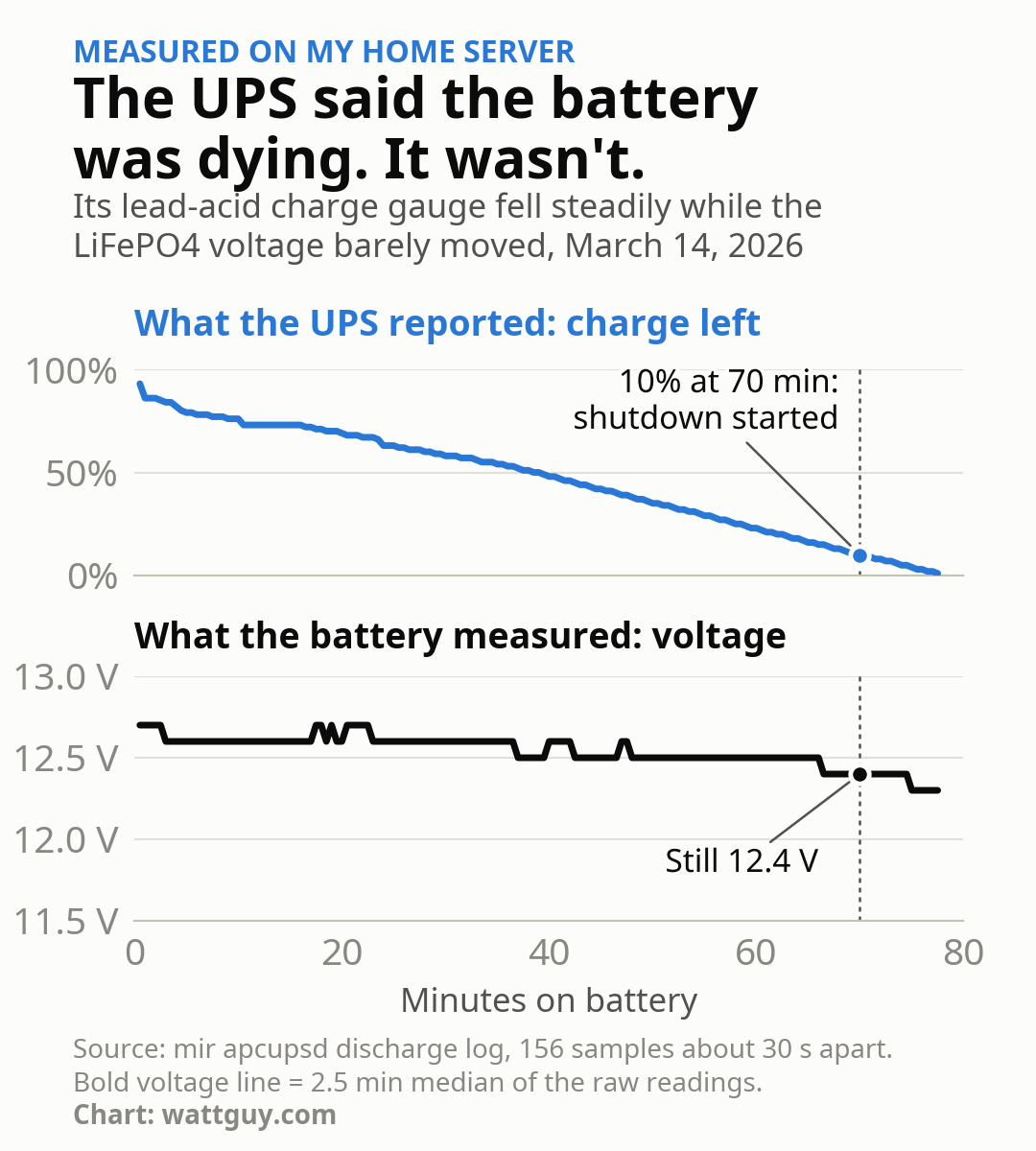
This behavior makes sense. An SLA battery’s falling voltage provides a useful clue about remaining charge. LiFePO4 spends much more of its discharge on a plateau. A voltage-based gauge calibrated for SLA can interpret small changes on that plateau as large changes in capacity.
RELiON makes the same point in its LiFePO4 charging guidance: a fuel gauge designed for lead-acid voltage will not display lithium state of charge accurately. A current-counting monitor can do better, but my UPS does not have one.
My earlier tests exposed both ways this mismatch can fail. On March 8, the UPS declared the battery exhausted after 64 minutes. On March 12, its hardware low-battery logic cut output near 12.5V, leaving substantial energy unused. On March 9, I went too far in the other direction: the battery’s BMS disconnected at 10.3V after 69 minutes, causing an abrupt power loss. Those tests survive only in my notes, so I am not graphing them as if I still had their raw data.
A real 76-minute outage confirmed the useful result
The controlled test was not the only evidence. On June 29, when the utility company disconnected my house to replace an aging meter box and upgrade to 200 AMP service. The power was cut at 8:08 a.m. The UPS transferred to battery six seconds later. Apcupsd reached its remaining-time limit and started the system shutdown at 9:24:31. That is 75 minutes and 50 seconds on battery, followed by a clean automatic shutdown.
The logs also show a one-minute event on June 25 and brief transfers on July 26, July 29, and September 5. Nine post-install self-tests through September 19 ended with Battery OK.
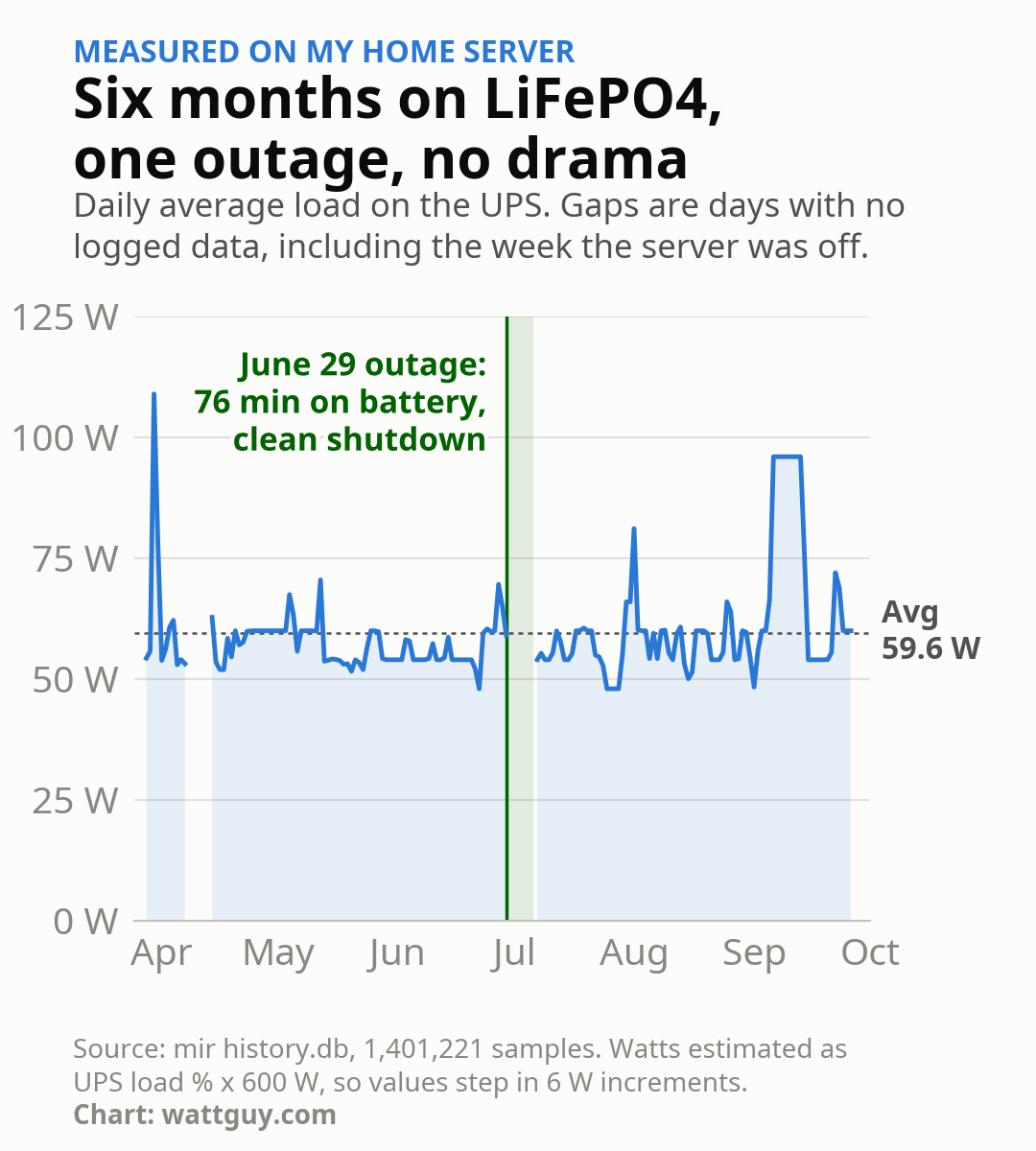
The history database contains 1.4 million samples from March 28 through September 26. Average estimated load was 59.6W, with recorded values from 48W to 204W. The long-run average is close to the controlled-test load, which helps explain why the real outage and bench-style unplug test ended at nearly the same time.
LiFePO4 vs SLA for UPS duty
The table compares my battery with representative published SLA data. It does not turn general specifications into a prediction of how long either chemistry will last in your UPS.
| Question | LiFePO4 reference | SLA or AGM reference |
|---|---|---|
| Nominal energy | ROCKSOLAR: 128Wh, 10Ah | APC APCRBC158: 12V, 9.4Ah |
| Voltage under load | Flat for most of my test, 12.7V to 12.4V before shutdown | Published CSB curve declines steadily, then falls sharply |
| Published cycle claim | ROCKSOLAR: 3,500 cycles to 80% capacity | Varies by product and depth of discharge; UPS SLA is intended mainly for standby service |
| Standby service life | Not established by my six-month test | Yuasa and CSB publish up to 5 years at 20 to 25C for representative small VRLA batteries |
| Self-discharge | Representative RELiON LiFePO4: less than 3% per month | Yuasa NP7-12: about 3% capacity loss per month at 20C |
| Storage | ROCKSOLAR says store at 40% to 60% charge | Store charged and recharge periodically; prolonged discharge promotes sulfation |
| Weight in the same 151 by 65mm footprint | ROCKSOLAR 10Ah: 1.27kg | Yuasa NP7-12: 2.2kg; CSB HR1234W: 2.5kg |
| Usable depth | My shutdown used 71Wh of 128Wh nominal; more remained | Deep discharge and time left discharged shorten life |
| Charging | ROCKSOLAR manual: 14.2 to 14.6V recommended charging range, 13.8V float | Small VRLA examples specify about 13.5 to 13.8V float and 14.4 to 15.0V equalization or cyclic charge |
| Heat | Do not charge this ROCKSOLAR below 0C; keep within its published range | Heat shortens VRLA life; Schneider says each 8C rise above its recommended range can halve life |
| Cost per year | Purchase price divided by actual years in service; mine is too new for an honest result | Same formula; lower purchase cost can still win in low-cycle standby use |
Shelf life, storage, and sulfation
Lead-acid wants to be stored charged. CSB says to recharge after discharge and warns that leaving a VRLA battery discharged can cause plate sulfation and permanent capacity loss. Schneider’s VRLA guidance recommends recharging stored UPS batteries at least every six months between -15 and 30C, and every three months at higher storage temperatures.
LiFePO4 tolerates partial state of charge much better. ROCKSOLAR’s instruction for this battery is to store it at 40% to 60%. That is a different job from standby UPS service, where the charger remains connected. Do not copy a storage recommendation into a live UPS without considering the charger and the connected load.
Cycle life is not the same as UPS service life
The 3,500-cycle claim sounds decisive next to lead-acid. It matters if you cycle the battery often. Most home UPS batteries spend nearly all their lives sitting on charge, then experience a few outages and self-tests. Heat, float behavior, calendar aging, BMS electronics, and the UPS charger may matter more than the laboratory cycle count.
Schneider says a typical VRLA battery reaches end of life around five years, and that heat accelerates aging. A warm UPS enclosure can erase years of service. My LiFePO4 battery has only been installed for six-plus months. I cannot yet claim it will outlive several SLA replacements.
Cost per year needs years, not marketing cycles
The defensible formula is simple: purchase price divided by actual years of useful service. Add any charger, monitor, wiring, or replacement cost required to make the system safe. A LiFePO4 battery can be cheaper per cycle and still cost more per year in a lightly used UPS if compatibility limits end its service early.
I will have a meaningful cost-per-year result only after this installation has accumulated years, not months. Until then, the measurable benefits are longer runtime in this setup, stable voltage, and lower weight.
LiFePO4 is not LiPo
LiFePO4 means lithium iron phosphate. It is not the lithium-polymer chemistry often shortened to LiPo. An NREL battery-safety review found that LiFePO4 cathodes have higher oxidative stability and a higher thermal-abuse onset than several layered-oxide lithium-ion chemistries.
That does not make a pack immune to short circuits, bad charging, physical damage, defective cells, or thermal runaway. A BMS is a necessary protection layer, not permission to ignore the battery maker’s limits.
Can a LiFePO4 battery be a drop-in UPS replacement?
Mechanically, mine was. Electrically and logically, the answer is conditional.
Some 12V LiFePO4 batteries are designed to work with suitable lead-acid charging profiles. My ROCKSOLAR unit is one of them, with a confirmed 14.2V to 14.6V charge range. Power-Sonic says a constant-voltage SLA charger can also be acceptable for its compatible lithium batteries if it stays within the specified voltage range and has no desulfation setting. RELiON says AGM and gel algorithms often fall inside LiFePO4 limits, while still recommending a lithium-specific profile.
That does not make every LiFePO4 battery SLA-charger compatible. Bioenno and Dakota Lithium recommend lithium-specific charging for their batteries. The specification for the exact battery wins over generic internet advice.
My APC sits at about 13.7V on mains, close to ROCKSOLAR’s 13.8V float setting but below its 14.2V to 14.6V recommended charging range. It has kept the pack in service, but it may not take the cells to a true 100% charge or trigger balancing the way a 14.6V charge would. More important, the UPS’s gauge remains wrong.
There is also a support issue. APC specifies its own sealed lead-acid cartridge for the BX1000M. A third-party lithium conversion is outside that replacement path and may affect warranty, certification, insurance, or equipment-protection coverage. I treat mine as an experiment I monitor, not an APC-approved upgrade.
How I made shutdown predictable
I stopped trying to extract the last watt-hour. The March tests showed why. If the UPS declares low battery too early, I lose runtime. If I wait for the BMS hard cutoff, the server loses power without finishing its shutdown.
Apcupsd is now configured with a 5% battery threshold and a five-minute runtime threshold. In practice, the UPS began shutdown at 10% during the March 14 test, at 12.4V. The June outage then produced a clean shutdown after nearly 76 minutes. The exact controls available depend on your UPS and operating system, so verify them with a supervised unplug test.
My practical checklist for a LiFePO4 battery for UPS use is:
- Match nominal voltage, case dimensions, terminal position, and F1 or F2 blade width.
- Check that continuous and surge current ratings exceed the UPS demand. My 10A battery is not appropriate for running this 600W UPS near full load.
- Require a built-in BMS with over-voltage, under-voltage, over-current, short-circuit, balancing, and temperature protection.
- Get written charging guidance for the exact battery. Avoid desulfation, pulse-repair, and equalization modes unless the battery maker explicitly permits them.
- Do not charge below the maker’s minimum temperature. This ROCKSOLAR lists 0C as its minimum charging temperature.
- Assume the UPS percentage and runtime estimate are wrong until a supervised test proves a safe shutdown margin.
- Keep enough margin that software shuts the computer down before the BMS disconnects.
LiFePO4 UPS FAQ
Can I use a lithium battery in a UPS?
Only when the exact battery’s voltage, current rating, BMS, charge requirements, physical size, and terminals are compatible. The UPS maker may not approve the conversion. Never use a lithium chemistry or a pack without a BMS merely because it fits.
How long does a UPS battery last?
Representative small VRLA makers publish three to five years of design or standby life at moderate temperature, but heat and deep discharge shorten it. LiFePO4 makers publish much higher cycle counts, yet calendar life in an SLA-designed UPS is a separate question. My installation has six-plus months of data, not a lifetime result.
Is LiFePO4 better than AGM for a UPS?
It can provide more usable energy in the same case, lower weight, a flatter voltage curve, and much higher published cycle life. AGM retains the advantages of native charger, gauge, warranty, and certification compatibility. Which is better depends on whether runtime and frequent cycling outweigh integration risk.
Why is my UPS charge percentage wrong with LiFePO4?
Many UPS gauges infer state of charge from behavior expected from lead-acid batteries. LiFePO4 voltage stays nearly flat through much of a discharge, so a lead-acid model cannot reliably translate voltage into remaining capacity.
Will a lead-acid UPS fully charge LiFePO4?
Not necessarily. Some battery makers permit compatible SLA voltage profiles, while others require a dedicated LiFePO4 profile. A lower float voltage may maintain the battery without reaching its advertised full capacity or completing top balancing. Follow the exact battery maker’s specification.
What happens when the LiFePO4 BMS reaches empty?
It can disconnect the battery abruptly to protect the cells. That is useful battery protection and terrible server shutdown behavior. Configure and test shutdown well before the BMS cutoff.
Method note: all local measurements came from apcupsd logs on my server, mir. The SLA curve is published reference data and is labeled as such. Product specifications belong to the named manufacturers and were checked on September 26, 2026. No affiliate links are used.