A generator vs power station decision comes down to two numbers: the watts your equipment needs and the hours it must run. Choose a battery power station for a modest, measured load that needs quiet indoor backup for a known period. Choose a fuel generator when the outage may last for days, the loads are heavier, and you have a safe outdoor operating location. If neither description fits cleanly, a smaller battery station plus an outdoor generator can use less fuel while keeping quiet loads on continuously.
The trap is comparing only output watts. A 1,800 W power station and a 1,800 W generator may start the same appliance, but the battery has a fixed supply measured in watt-hours (Wh). A generator can keep making energy as long as it is operated safely and refuelled.
This is a research-based comparison, not a product test. Watt Guy has not handled or measured the example equipment. Specifications come from current manufacturer documentation, while the safety rules come from CPSC, Health Canada, and Ontario’s Electrical Safety Authority.
Last updated: October 22, 2026
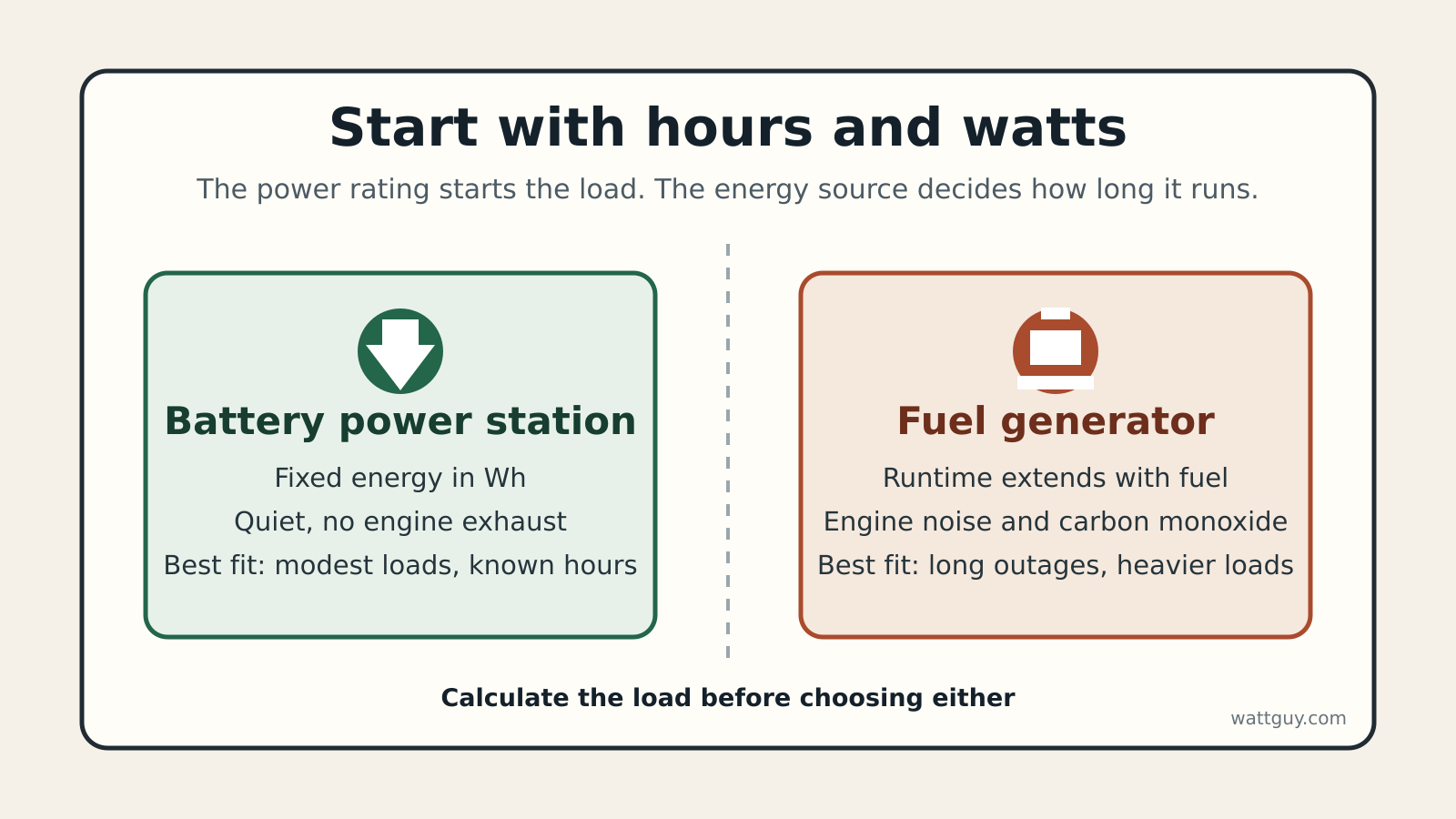
Start with hours and watts
Running watts tell you whether a source can support the load. Startup or surge watts tell you whether it can start a compressor, pump, or motor. Energy tells you how long the source can do the job. Record all three before shopping.
A plug-in power meter is useful for equipment that cycles. For everything else, use the nameplate or manual, then build a load list in Watt Guy’s Home Backup Power Calculator. The calculator keeps continuous watts, startup demand, and outage duration separate, which prevents a large watt rating from disguising a battery that is too small.
Generator vs power station at a glance
Outage power comparison. Exact limits depend on the model and load.
| Decision factor | Battery power station | Fuel generator |
|---|---|---|
| Energy supply | Fixed battery capacity in Wh | Extends with safely stored fuel |
| Output limit | Continuous and surge W | Rated and maximum W |
| Best outage shape | Shorter, predictable, modest loads | Longer or uncertain, heavier loads |
| Noise and exhaust | Fan noise, no engine exhaust | Engine noise and lethal carbon monoxide risk |
| Recharging or refuelling | Grid, compatible solar, or approved vehicle input | Fuel, engine cooldown, and maintenance |
| Typical upkeep | Storage charge and periodic checks | Fuel, oil, starting, and scheduled service |
| Indoor use | Follow battery manual, ventilation, and temperature limits | Never |
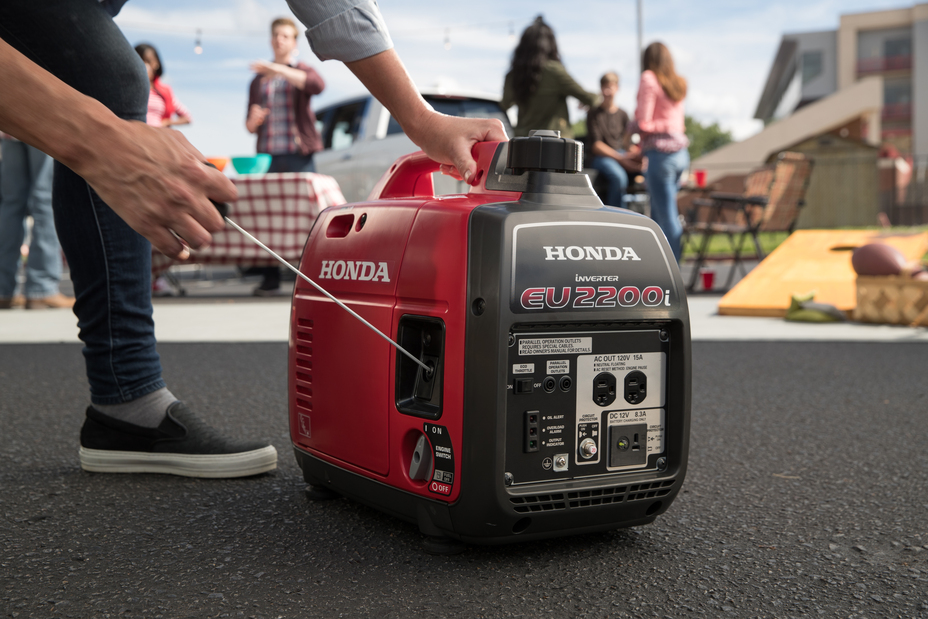
Current examples show why watts alone mislead. The Anker SOLIX C1000 specifications list 1,056 Wh of battery capacity and 1,800 W of AC output. The Honda EU2200i specifications list 1,800 W rated output and 2,200 W maximum output, plus 3.2 hours at rated load or 8.1 hours at one-quarter load on its 0.95 US gallon tank. Similar output ratings do not create similar energy limits.
An eight-hour load budget exposes the difference
Consider an illustrative outage load: 40 W for networking and lights, 60 W for a laptop and display, and an 80 W average allowance for a refrigerator that cycles. The average is 180 W. Over eight hours, the load needs 1,440 Wh before conversion losses and idle consumption.
A 1,056 Wh station cannot deliver 1,440 Wh, even in a physically impossible loss-free case. Its absolute ceiling at 180 W is 5.9 hours, and real runtime will be shorter. A 2,048 Wh station has 608 Wh of nameplate margin before losses, reserve, temperature effects, and battery cutoffs. That is the useful way to compare capacity.
The refrigerator’s startup demand remains a separate gate. An average-energy calculation cannot prove that either source will start its compressor. Measure the peak or use the appliance documentation, then compare it with the source’s surge limit and the manufacturer’s rules for motor loads.
A battery station wins when the load is known
A power station is the cleaner fit for an apartment, a night of router and laptop use, or any setting without a safe generator location. It can sit near the equipment, starts without fuel handling, and does not produce combustion exhaust. The remaining drawbacks are substantial: finite energy, long solar recharge times in poor weather, battery aging, and a weight that climbs quickly with capacity.
Do not assume its backup mode equals a UPS. The Anker example specifies a 20 ms transfer time, while sensitive equipment may need a faster transfer. For a modem and router that must stay online through a brief flicker, a dedicated unit from the UPS choices for network gear is usually the more direct tool.
A generator wins when duration is the unknown
A generator is easier to justify when a storm may turn eight hours into three days, or when pumps, refrigeration, and other loads would demand an impractically large battery. Refuelling extends runtime, subject to the model’s duty cycle, maintenance, and fuel availability. It can also support a high continuous load without buying enough battery capacity for every hour in advance.
The compromises arrive with the engine. The Honda example weighs 47.4 lb dry and is rated at 48 to 57 dB(A), depending on load. It needs fuel, oil, starting checks, cooldowns, and a secure operating location. Even a quiet inverter generator is not quiet beside a neighbour’s window.
A hybrid setup can shrink both compromises
A battery station can carry a 180 W overnight load without engine noise, while a generator runs outdoors during selected daytime charging periods. That arrangement can reduce generator hours and preserve fuel. It also adds cost, conversion losses, and another charging specification to verify.
Check that the generator output is acceptable to the power station charger and that the charger does not overload the generator alongside other equipment. Follow both manuals. Solar can serve the same recharge role, but panel nameplate watts are not guaranteed delivery, and clouds make it a variable input rather than a firm outage plan.
Safety rules can decide before the math does
Fuel generators produce carbon monoxide, a colourless and odourless poison. The US Consumer Product Safety Commission says to use a portable generator outside only, at least 20 feet from a home, with the exhaust facing away. Never run one in a home, garage, basement, shed, porch, or carport, even with doors or windows open. Health Canada gives the same 6 metre or 20 foot minimum and says to direct exhaust away from openings in its carbon monoxide guidance.
Never connect a generator to a household outlet to backfeed the home. That is illegal and can kill utility workers. The Electrical Safety Authority’s generator guidance requires approved transfer equipment for a permanent connection and recommends a Licensed Electrical Contractor. Panel, transfer-switch, and hardwired work needs a licensed electrician and permits where required.
A battery station avoids combustion exhaust, but its lithium battery is not fireproof or risk-free. Use the supplied or manufacturer-approved charger, keep ventilation openings clear, stay inside the manual’s charging and storage temperature limits, and stop using a pack that is damaged or swollen. Watt Guy’s LiFePO4 and lithium-ion comparison explains why chemistry alone is not a complete safety claim.
Who should skip each option
Skip a fuel generator if you cannot maintain at least 20 feet of outdoor separation from buildings, doors, windows, and air intakes. That rules out many apartments and dense urban properties. Skip it if noise restrictions, fuel storage, physical starting, or regular engine maintenance make safe use unrealistic.
Skip a battery station if the required energy is several times its usable capacity and there is no credible recharge plan. It is also the wrong tool when the load exceeds its continuous or surge rating. Medical equipment needs a device-specific backup plan made with the equipment supplier and care team, not a generic runtime estimate.
For a known 180 W load over one night, I would pick a power station sized with real loss margin. For an uncertain multi-day outage with a compliant outdoor location, I would pick a generator or a hybrid setup. The winning label matters less than a load list that survives both the watt check and the hour check.
How this comparison was researched
Watt Guy reviewed manufacturer specifications for the example Anker power station and Honda generator, plus current generator-safety guidance from CPSC, Health Canada, and ESA. The load budget is an illustrative calculation, not a measured appliance profile. No product was tested, no runtime was measured, and no linked source pays Watt Guy.