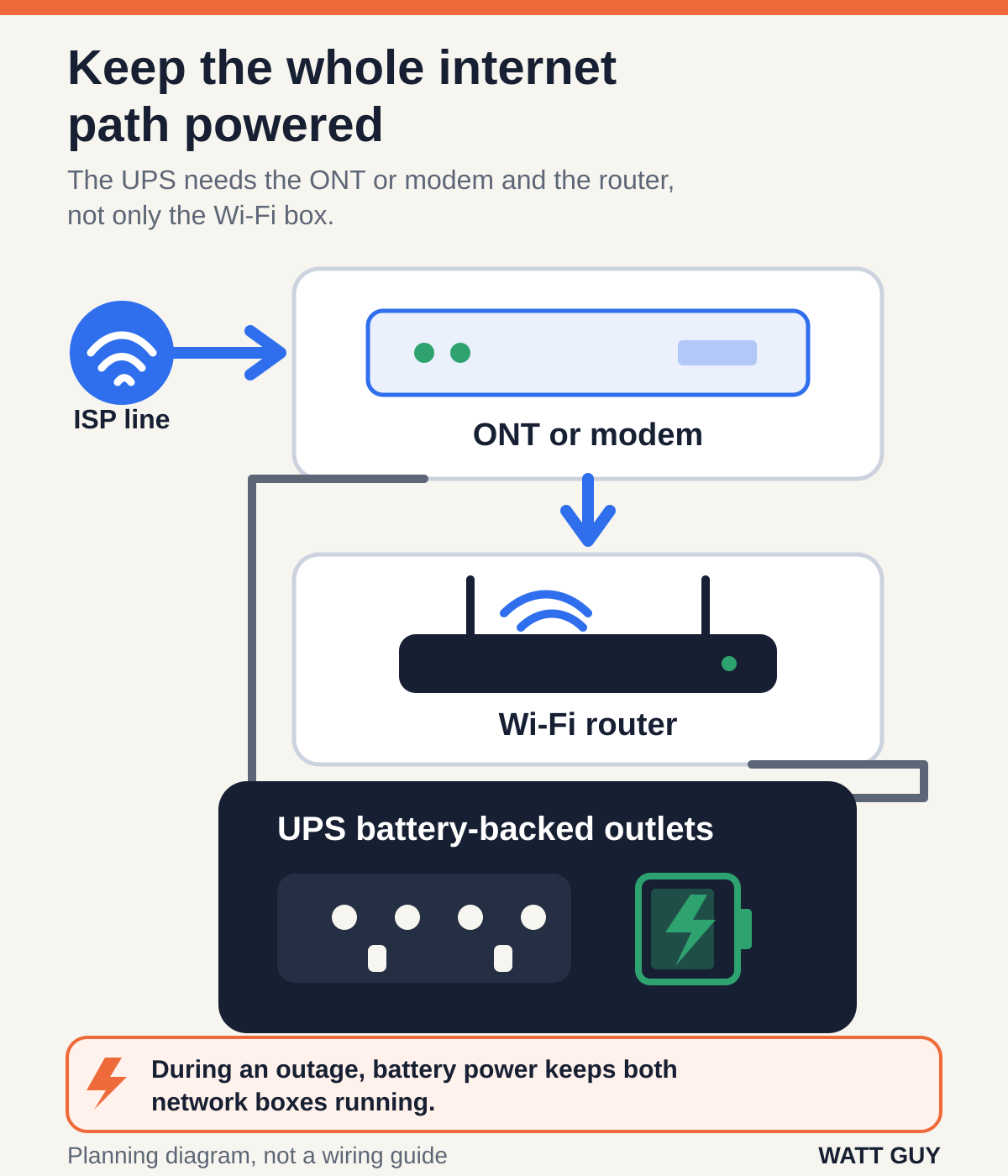
A glowing Wi-Fi router is useless if the modem or fibre ONT beside it has shut down. The APC Back-UPS BE600M1 is my default for keeping that whole path alive: its five battery-backed outlets and replaceable battery suit a small network, and the 25 W planning model lands around an hour. It costs more than the smallest standby models and supplies a stepped battery waveform, so it is not the right choice for every shelf.
This is a research-based guide. Watt Guy has not tested these five units. Runtime ranges below are planning estimates built from each manufacturer’s battery rating and the assumptions stated in the sizing section, not measured product results.
Last updated: October 20, 2026
Back up every box between the ISP and Wi-Fi
A fibre connection may have an optical network terminal, or ONT, as well as a separate router. Cable service usually has a modem and router, sometimes combined in one gateway. Put every required power adapter on a battery-backed outlet. A glowing router cannot reach the internet if the ONT or modem beside it has gone dark.
The comparison uses a 25 W combined load to represent a modest ONT or modem plus router setup. Replace that figure with a plug-in power-meter reading if possible. Prices and direct stock were checked on October 20, 2026 at B&H in the United States and DeployDepot in Canada.
Quick comparison for a 25 W network load. Runtime is a planning range, not a manufacturer guarantee.
| Model | Battery and output | Battery outlets | 25 W planning range | Checked price | Main compromise |
|---|---|---|---|---|---|
| APC BE600M1 | 78 Wh SLA, 330 W | 5 | 54 to 78 min | US$85.99; CA$110.99 | Stepped waveform |
| CyberPower ST425 | 34.8 Wh SLA, 260 W | 4 | 20 to 28 min | US$59.95; CA$74.99 | No USB data or charging |
| CyberPower ST625U | 66 Wh SLA, 360 W | 4 | 44 to 63 min | US$79.95; CA$96.99 | Battery is not user-replaceable |
| CyberPower SL700U | 66 Wh SLA, 370 W | 5 | 44 to 63 min | US$89.95 | Costs more for its slim layout |
| CyberPower CP850PFCLCD | 108 Wh SLA, 510 W | 5 | 81 to 117 min | US$169.95; CA$209.99 | 14.9 lb and expensive for network gear |
Five UPS choices by the constraint that matters
APC BE600M1 for a repairable everyday setup
The APC Back-UPS BE600M1 is the sensible default when the network cabinet has three to five essential plugs. It provides 600 VA or 330 W, five battery-backed outlets, two surge-only outlets, and a 6 ms typical transfer time. APC specifies the APCRBC154 replacement battery, which gives this model a better service path than sealed units that treat battery failure as end of life.
The drawbacks are plain. Its battery output is a stepped approximation to a sine wave, the only charging port is a 1.5 A USB-A connection, and the case is larger than a dedicated DC router backup. At CA$110.99 or US$85.99, it makes the most sense for readers who value a replaceable battery more than the lowest initial price. Readers who prioritize the lowest upfront cost or require pure sine-wave output should leave it off the list.
CyberPower ST425 for short cuts on a small budget
The CyberPower ST425 covers a basic modem and router when the goal is riding through brief interruptions, not a long blackout. Its 12 V, 2.9 Ah sealed lead-acid battery stores 34.8 Wh on paper. Four of its eight outlets receive battery power, and the 425 VA unit is rated for 260 W, far above a small network load.
That small battery is also the reason to skip it for hour-long outages. The 25 W model lands at only 20 to 28 minutes, and CyberPower does not make the battery user-replaceable. There is no USB data connection or USB charging port. The reward is a low US$59.95 or CA$74.99 checked price and a compact 3.8 lb case.
CyberPower ST625U for more battery per dollar
The CyberPower ST625U moves to a 12 V, 5.5 Ah battery and a 625 VA or 360 W ceiling. Two USB-A charging ports share 2.1 A, while a separate USB data connection supports CyberPower’s monitoring software. The estimated 44 to 63 minutes at 25 W is a useful step up from the ST425 for only about US$20 more.
Only four outlets are battery-backed, even though the case has eight receptacles. The output remains simulated sine wave, transfer time is 8 ms, and battery replacement is listed for a qualified technician rather than the owner. This is a poor fit for anyone who expects to replace the battery without a technician or needs a fifth backed outlet; the APC handles both priorities better.
CyberPower SL700U for a shallow shelf or wall
The CyberPower SL700U spreads its hardware across a 2.76-inch-thick case with five battery-backed outlets. CyberPower describes it for wall-mount applications, and the rotating power cord helps when a conventional tower would crowd a network shelf. It also includes USB monitoring and two USB-A charging ports with 2.4 A shared output.
Its 12 V, 5.5 Ah battery is the same nominal energy as the cheaper ST625U, so the 25 W planning range is also 44 to 63 minutes. The US$89.95 price buys the shape and one extra backed outlet, not more stored energy. Its internal battery is not user-replaceable. Readers without a shelf-depth or wall-mount constraint should skip it.
CyberPower CP850PFCLCD for a NAS beside the router
The CyberPower CP850PFCLCD is the outlier for a network shelf that also carries a NAS, small server, or other gear that benefits from pure sine-wave output and automatic voltage regulation. It uses a 12 V, 9 Ah user-replaceable battery, supplies 850 VA or 510 W, and has a 4 ms transfer time. The LCD shows load and battery conditions without opening an app.
At a network-only 25 W load, the model estimates 81 to 117 minutes. That extra reserve costs US$169.95 or CA$209.99, and the 14.9 lb tower is not subtle. For a modem and router alone, skip it. Choose this one only for the additional equipment, pure waveform, or voltage regulation rather than its larger number on the box.
Size a UPS for modem and router duty
Start by adding the watts for the ONT, modem, router, mesh nodes, and any Ethernet switch that must stay online. Do not use the UPS VA number as battery capacity. VA and W describe the largest load the inverter can support, while Wh describes stored energy.
For a worked example, suppose a power meter shows 25 W for the full network path. The ST625U battery is rated at 12 V and 5.5 Ah, or 66 Wh. Entering 66 Wh, a 25 W load, sealed lead-acid chemistry, 100 percent battery health, 70 percent battery-mode efficiency, and a 10 percent reserve in Watt Guy’s UPS Runtime Calculator produces about 55 minutes, with a 44 to 63 minute planning range.
The estimate applies a lead-acid discharge-rate penalty and is deliberately cautious about light-load inverter efficiency. Battery age, temperature, cutoff behavior, and the actual UPS curve can move the result. Measure the load, check the manufacturer’s runtime chart, and perform a supervised outage test before relying on the number.
If the network is one part of a wider outage plan, the Home Backup Power Calculator separates energy, running watts, and startup demand for the rest of the household loads.
A powered router cannot repair an ISP outage
A UPS solves loss of power inside your home. It cannot restore a damaged fibre line, an unpowered neighbourhood cabinet, or an ISP outage upstream. Cellular backup may be a better second layer when internet continuity matters more than keeping one connection alive.
Count the plugs before ordering. Put only the equipment needed for connectivity on battery-backed outlets. A desktop PC, monitor, speaker, or printer can consume the reserve intended for the network, and a surge-only outlet will turn off during the outage even though it sits on the UPS.
Who should skip a network UPS
Skip these small AC models if the goal is running a medical device, pump, laser printer, heater, or other high-drain equipment. CyberPower specifically excludes high-drain devices, medical equipment, and laser printers from these products. Medical power continuity needs a device-specific plan with the equipment supplier and care team.
A direct-DC backup can waste less energy when it matches the router’s voltage, connector, polarity, and current requirements exactly. It is not a universal shortcut. Readers who cannot verify those details should stay with the original AC adapters and a listed UPS.
Safety, batteries, and research limits
CyberPower lists UL 1778 and cUL certification for the four CyberPower models above. UL Solutions describes UL 1778 as the standard for uninterruptible power systems. Certification does not remove the need to follow the exact model manual, leave ventilation clear, and keep the unit dry.
Battery replacement must use the type and model the UPS manufacturer identifies. Do not treat a lead-acid replacement as permission to install another chemistry. Watt Guy’s LiFePO4 UPS battery test explains why charging, state-of-charge reporting, terminals, case fit, and shutdown behavior all matter, and why that swap was not manufacturer-approved.
Specifications came from current APC and CyberPower product pages and manuals. Stock and prices were checked at established US and Canadian retailers on October 20, 2026. No unit in this guide was handled or tested by Watt Guy, and no retailer link is an affiliate link.