LiFePO4 vs lithium ion is usually framed as two separate battery types, but LiFePO4 is a lithium-ion chemistry. The useful comparison is lithium iron phosphate, shortened to LFP, against the nickel-based lithium-ion chemistries commonly used where size and weight matter. For backup power and frequent cycling, I would usually choose LFP. For a device that must be as light and compact as possible, a conventional high-energy lithium-ion pack can be the better fit.
Last updated: October 18, 2026
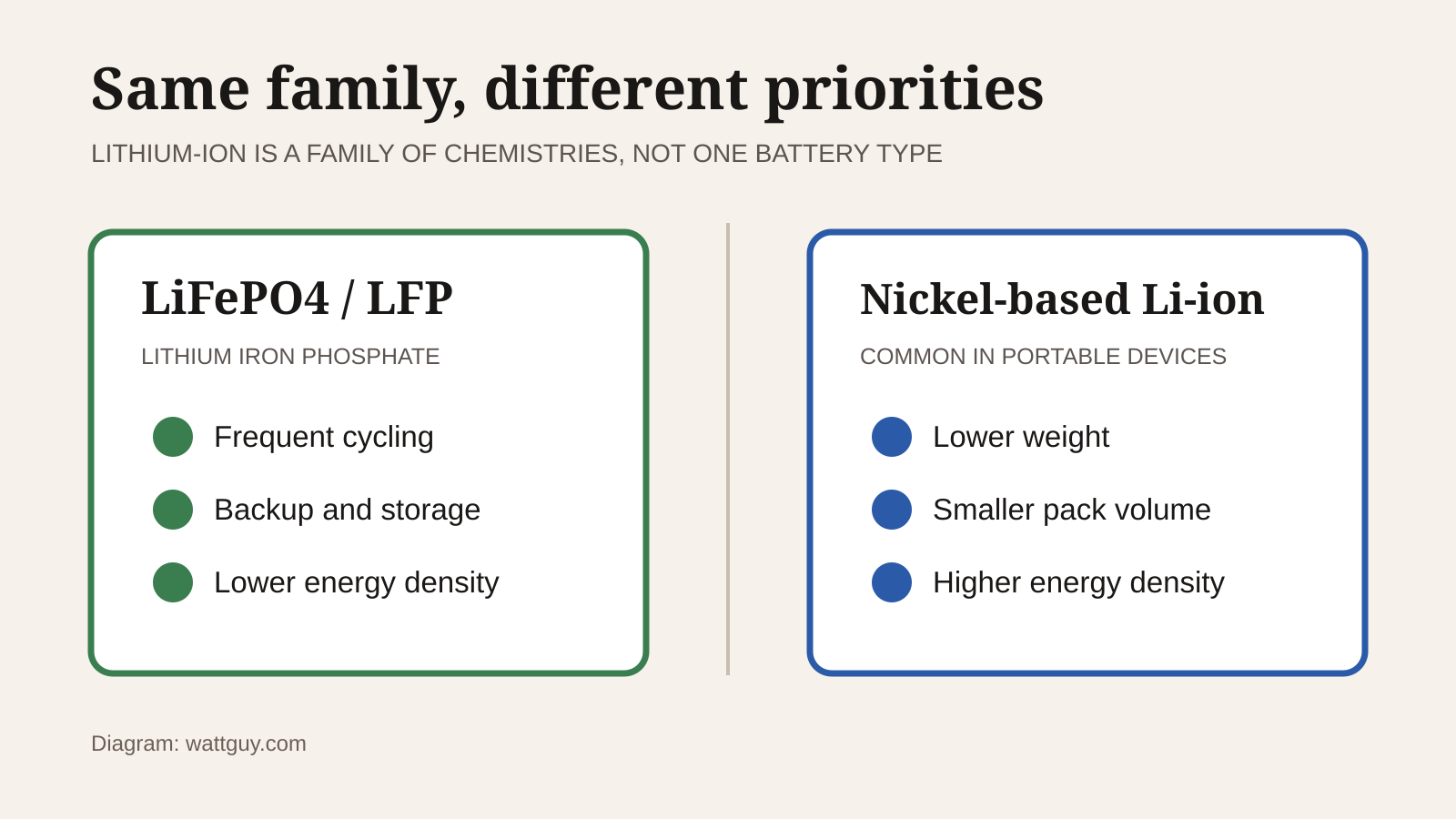
Chemistry does not decide runtime by itself. A 500Wh LFP power station and a 500Wh nickel-based power station start with the same rated energy. Usable capacity, inverter efficiency, standby draw, and the load in watts decide how long either one runs.
This is a research-based comparison, not a battery test. I reviewed US Department of Energy material, current manufacturer cell specifications, and lithium-ion safety guidance from UL Research Institutes and Health Canada. Watt Guy has not bench-tested the cells or power stations discussed here.
LiFePO4 vs lithium ion at a glance
Battery chemistry comparison. These are directional differences, not promises for every cell or finished pack.
| Decision factor | LiFePO4 (LFP) | Nickel-based lithium ion |
|---|---|---|
| Typical priority | Long cycle life and stationary storage | More energy in less mass and volume |
| Nominal cell voltage | About 3.2V | Commonly about 3.6V |
| Energy per kilogram | Lower in representative cells | Higher in representative cells |
| Cycle-life tendency | Higher under stated test conditions | Often lower, but cell design and use matter |
| Thermal behaviour | Lower cathode reactivity, not risk-free | Higher energy density demands strong pack protection |
| Best fit | Power stations, solar storage, frequent backup use | Phones, laptops, drones, light portable packs |
LiFePO4 is already a lithium-ion battery
Lithium ion names a family, not one recipe. The US Department of Energy describes lithium-ion as a family of chemistries that transfer lithium ions between electrodes. LFP identifies the cathode material: lithium iron phosphate. NMC uses nickel, manganese, and cobalt, while NCA uses nickel, cobalt, and aluminum.
That distinction matters when a listing says only “lithium ion.” It does not tell you the cathode chemistry, cycle rating, or usable energy. Look for LFP, LiFePO4, NMC, or NCA in the specifications, then check the complete pack rather than treating the chemistry label as a quality score.
LFP trades some energy density for cycle life
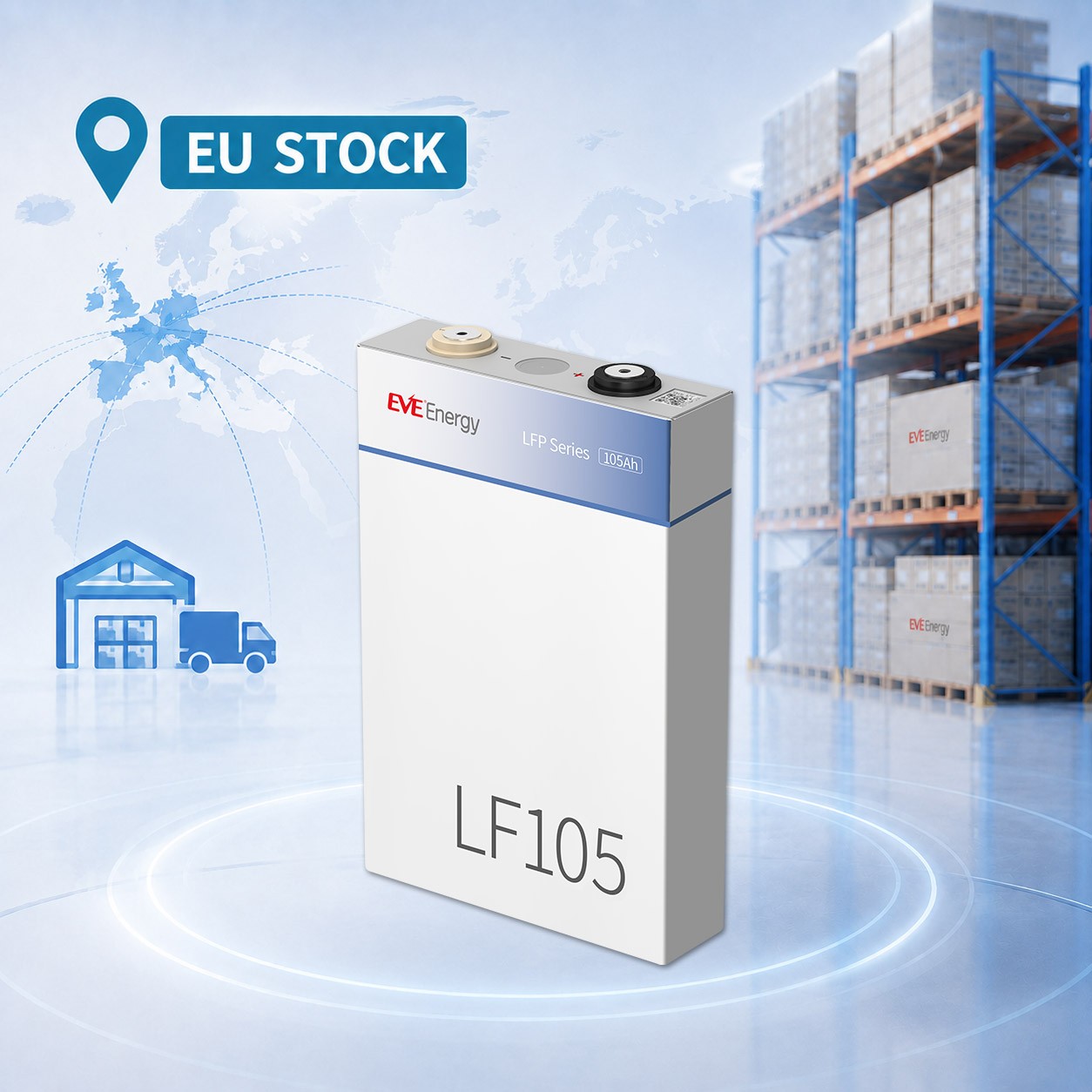
Representative cell data shows the basic trade. EVE lists its LF105 LFP cell at 3.2V, 105Ah, and 1.98kg. That works out to 336Wh and roughly 170Wh/kg. EVE rates it for 5,000 cycles to 80 percent state of health at 25 degrees C with 0.5C charging and discharging.
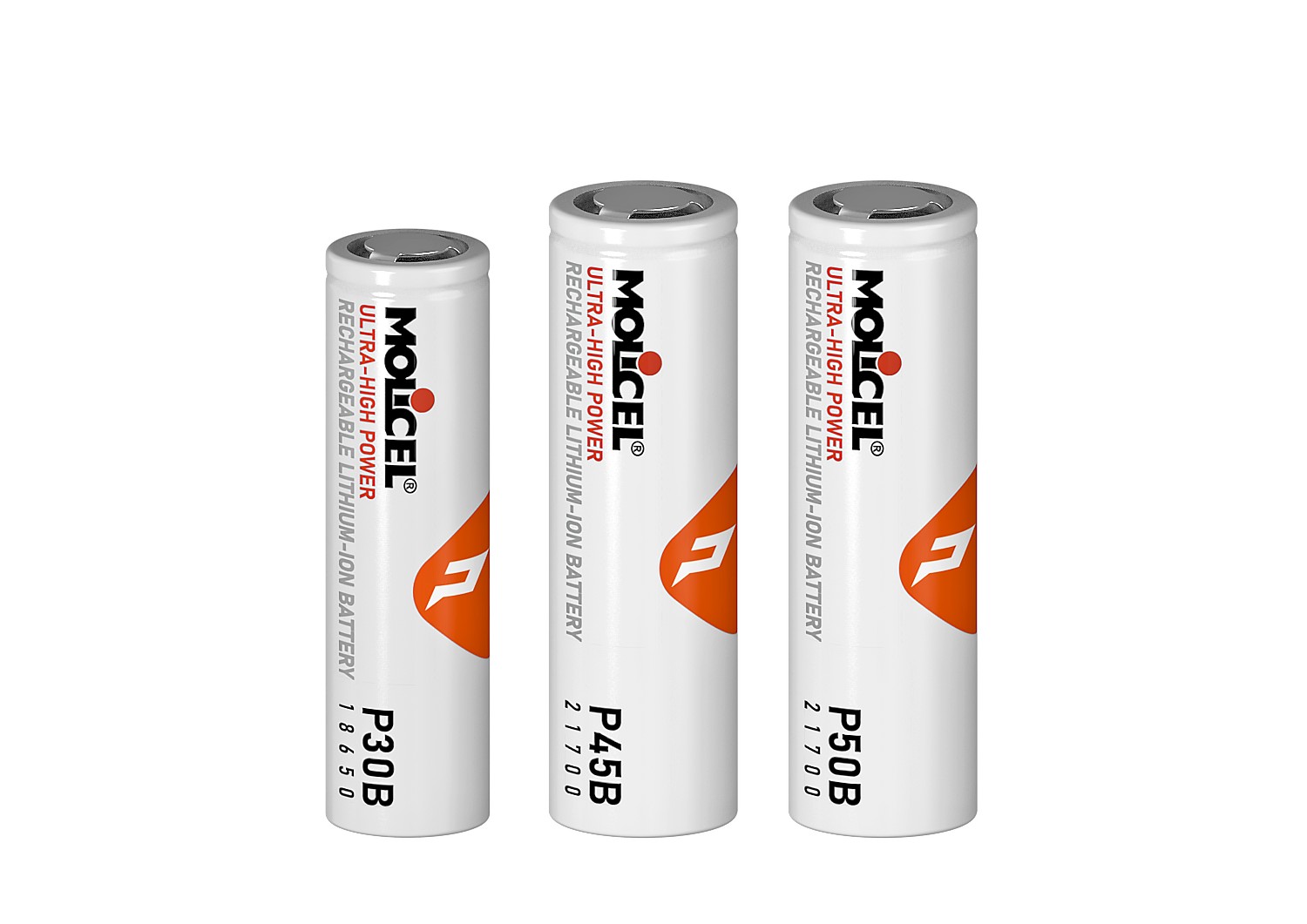
Molicel lists its P45B high-power lithium-ion cell at 3.6V, 4.5Ah, and 242Wh/kg. The two cells have different formats, capacities, and intended jobs, so they are examples rather than a controlled head-to-head test. They show why a lighter battery can use a high-energy chemistry even when LFP offers the more attractive cycle claim.
Cycle numbers also need their fine print. Temperature, charge rate, discharge rate, depth of discharge, storage charge, and the manufacturer’s end-of-life threshold all affect the result. A claim of 3,000 cycles to 80 percent capacity is not directly comparable with 3,000 shallow cycles or a rating that omits the test conditions.
Choose LFP for frequent backup and stationary use
LFP makes the most sense when the battery will be cycled often and a few extra kilograms will not change how it is used. That includes a power station kept beside a desk, a van battery secured in place, or storage charged regularly from solar. A long cycle specification can spread the purchase cost across more charge and discharge events.
It is less decisive for an emergency pack used twice a year. Calendar aging, electronics, warranty coverage, and whether the battery is kept at a sensible temperature may matter before the theoretical cycle count does. A heavy unit can also be a poor backup choice if the intended user cannot move it.
Choose higher-energy lithium ion when weight wins
Nickel-based lithium-ion chemistries earn their place when the product needs a lot of energy in a small enclosure. Phones, laptops, camera batteries, drones, and many power banks are designed around that advantage. You normally cannot choose a different chemistry without choosing a different finished product.
For a portable power station, compare kilograms per usable kilowatt-hour rather than assuming one label is lighter. Enclosures, inverters, cooling, handles, and chargers contribute to the final mass. Two finished products can reverse the cell-level trend if one has much heavier supporting hardware.
How to size either chemistry by Wh and W
Start with the load, not the chemistry. Suppose a workstation and monitor average 75W and need to run for six hours. The load requires 75W x 6 hours, or 450Wh.
Now allow for conversion losses and reserve. Using 85 percent as a planning assumption, 450Wh divided by 0.85 equals 529Wh. I would shop at 600Wh or above, then check that the inverter’s continuous watt rating exceeds the workstation’s measured load and any startup peak.
The 85 percent figure is an estimate, not a claim for every power station. Manufacturer usable-capacity limits, AC inverter efficiency, temperature, and standby consumption change the answer. Watt Guy’s UPS runtime calculator shows the same relationship between battery energy, load, and efficiency for desk backup.
Cold weather needs a specification check
Cold slows lithium-ion chemistry and can reduce both output and charging efficiency. Do not turn “LFP dislikes cold” into a universal temperature cutoff, because finished packs use different cells, sensors, heaters, and battery-management rules. Check the exact product’s allowed charge, discharge, and storage ranges.
Health Canada advises bringing larger lithium-ion batteries to room temperature and not attempting to charge them below 0 degrees C. A pack with low-temperature charge protection is useful for an unheated garage or vehicle, but it does not make every cold-weather use acceptable. Follow the manufacturer’s limits.
Neither chemistry is fireproof
LFP has lower thermochemical reactivity than several high-energy cathodes, but calling it safe or fireproof skips the rest of the pack. Cell quality, physical damage, wiring, thermal management, the battery-management system, and the charger all affect risk. UL Research Institutes explains that thermal runaway can produce extreme heat, gas, smoke, or fire in a lithium-ion cell.
Health Canada’s lithium-ion guidance says to use the original or a compatible certified charger, charge where the device can be seen, and stop using damaged, swollen, or modified batteries. Canadian buyers should look for a recognized Canadian certification mark on the charger. Do not put worn-out lithium-ion batteries in household garbage; use the municipal hazardous-waste or battery-recycling route.
Do not swap chemistry in an existing device
A different nominal voltage means a different series-cell count, charging profile, cutoff behaviour, and battery-management requirement. Matching only the case size and advertised amp-hours is not enough. Use the chemistry and replacement pack approved by the device manufacturer.
Watt Guy’s LiFePO4 UPS battery experiment documents one non-approved SLA replacement, including charge-percentage errors and compatibility limits. It is evidence from one UPS, not a general swap procedure.
Who should skip this comparison
If you are buying a phone, laptop, tool, or sealed power bank, chemistry is rarely the first decision. Runtime, output power, certification, warranty, repair support, and total product weight are more useful filters. The manufacturer has already designed the charging system around its chosen cells.
Skip chemistry-first shopping if the pack does not publish usable Wh, continuous W, temperature limits, or cycle-test conditions. A vague LFP label cannot compensate for missing specifications. For stationary home energy storage, use a listed complete system and a qualified installer rather than assembling or modifying a pack from this comparison.
My practical choice
I would pick LFP for a power station or solar-storage battery that will sit in one place and cycle regularly. I would accept a nickel-based lithium-ion pack for a device carried every day when lower mass and smaller volume matter more than a large cycle count. In both cases, I would size by usable Wh and continuous W, then verify certification, operating temperature, warranty, and charger compatibility.
The chemistry label narrows the tradeoff. It does not replace the finished product’s specifications.